

Olympic Artist Charles Billich Visits Crostars — Where Surrealism Meets the Sky
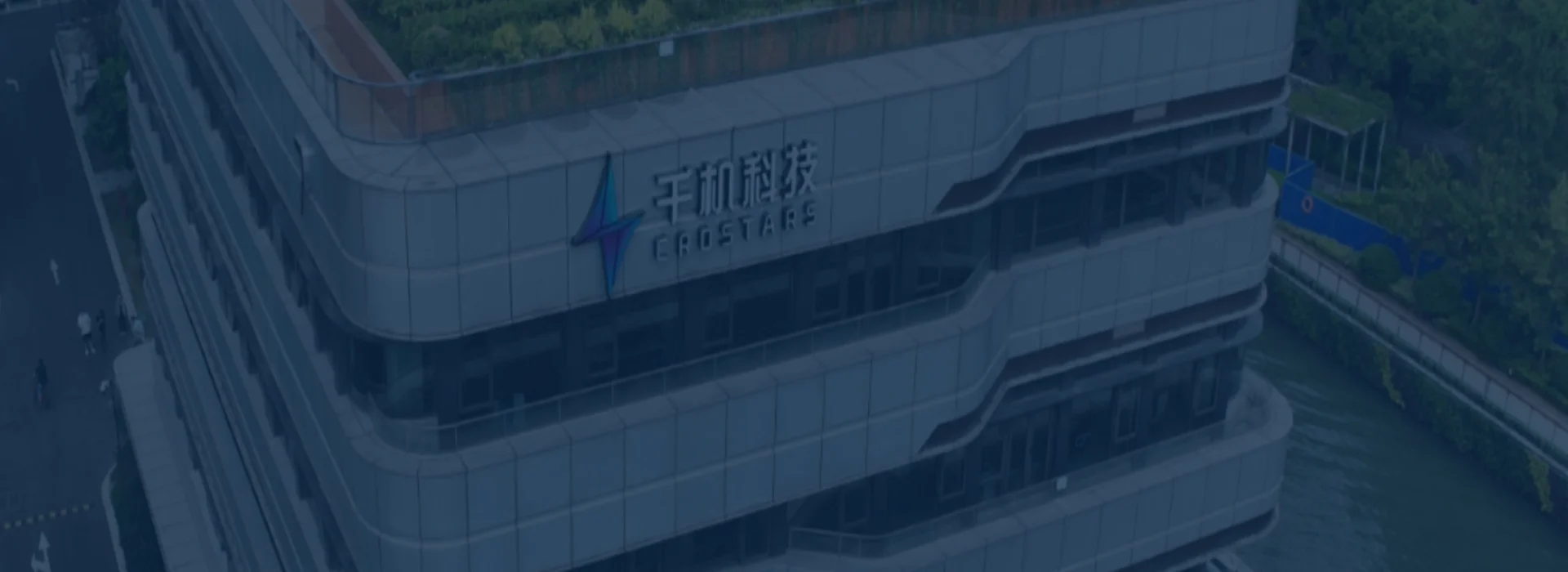
Charles Billich doesn’t visit drone companies. He paints cities — enormous, sweeping cityscapes that have followed the Olympic Games across 28 countries, each one commissioned as a permanent record of a host city’s soul. So when he and his wife Christa made their way to the Crostars headquarters in Shanghai last month, it wasn’t a routine courtesy call. It was a question he’d been carrying for a while, and he’d come to see if we had an answer.
The question, put plainly when he finally said it out loud in our studio: “How can drones interpret our work?”
Starting with the C5
Chairman Shi Zheyuan took the group through the Crostars showroom first — the company’s history since 2017, the global performance record, the awards, and then the hardware. The C5 drone light show system was the centerpiece.
Each C5 drone carries a 16.77-million-color RGB lighting array and is engineered to hold precise formation at speeds up to 12 m/s, for shows lasting up to 25 minutes. The specs matter less than what they make possible: in a swarm of hundreds, each drone becomes a single pixel in a moving image drawn across open sky. For an artist whose entire career has been about painting cities at their most expansive, the scale of that canvas wasn’t lost on Billich.
Before the conversation properly began, both sides watched two performances together on screen. One was a custom aerial show built for the Burning Man Festival in the American desert in 2024. The other was a light display created for the International Olympic Arts Committee’s 30th anniversary celebration in Paris, in July this year. Neither was background viewing — Billich watched them carefully.
What Shi Zheyuan Said About Art

Shi Zheyuan said, Crostars has always been a technology company first — patents, R&D, engineering. But technology without cultural purpose is just machinery. “We want to build something where cold technology meets warm culture and art,” he told the group. “A space to explore what artistic presentation can become.”
Billich didn’t just nod politely. He said the idea matched how he’d been thinking about his own work for years — that the cityscape, as a form, had always been about more than documentation. It was about feeling. And drones, it turned out, could carry that.
How Crostars Showed Billich What a Drone Show Looks Like

The most memorable moment of the afternoon wasn’t a presentation slide. It was a live demonstration in the design studio, after Billich asked his core question.
One of the Crostars animators pulled up a flat illustration of Nezha (哪吒) — a figure from Chinese mythology and a recent blockbuster film. Then walked through the conversion process in real time. Point-matrix layout. 3D modeling. Flight path programming. Within minutes, a static drawing became a sequence of positions for a swarm of drones, ready to paint that image in light across a night sky. The static became kinetic. The flat became three-dimensional.
The Global Landmark Plan and Sky Art Gallery
Shi Zheyuan also introduced two longer-horizon projects. The Global Landmark Summit Initiative connects iconic locations worldwide with drone performances that carry genuine artistic and cultural weight. Not just spectacle. The Sky Art Gallery is a planned network of 100+ venues globally, beginning with Shanghai, where drone shows become a permanent part of a city’s cultural identity.
As Global Chairman of the World Low-Altitude Economy Arts Development Committee, Shi Zheyuan described a specific vision. Chinese manufacturing and drone engineering, he said, could become the infrastructure for a new kind of international cultural exchange. The ambition isn’t subtle: use the sky as a medium, and build something that can travel.
Billich was once asked by the Beijing Olympic bid committee to paint the city’s thousand-year history. The idea of a Chinese technology company building that kind of cultural platform clearly landed with some weight.
More About “Crostars”
Crostars has been building toward this kind of collaboration for a long time. If you’re interested in what a custom drone art performance can look like for your event or institution, you can explore our show portfolio, read more about us, or get in touch directly.